
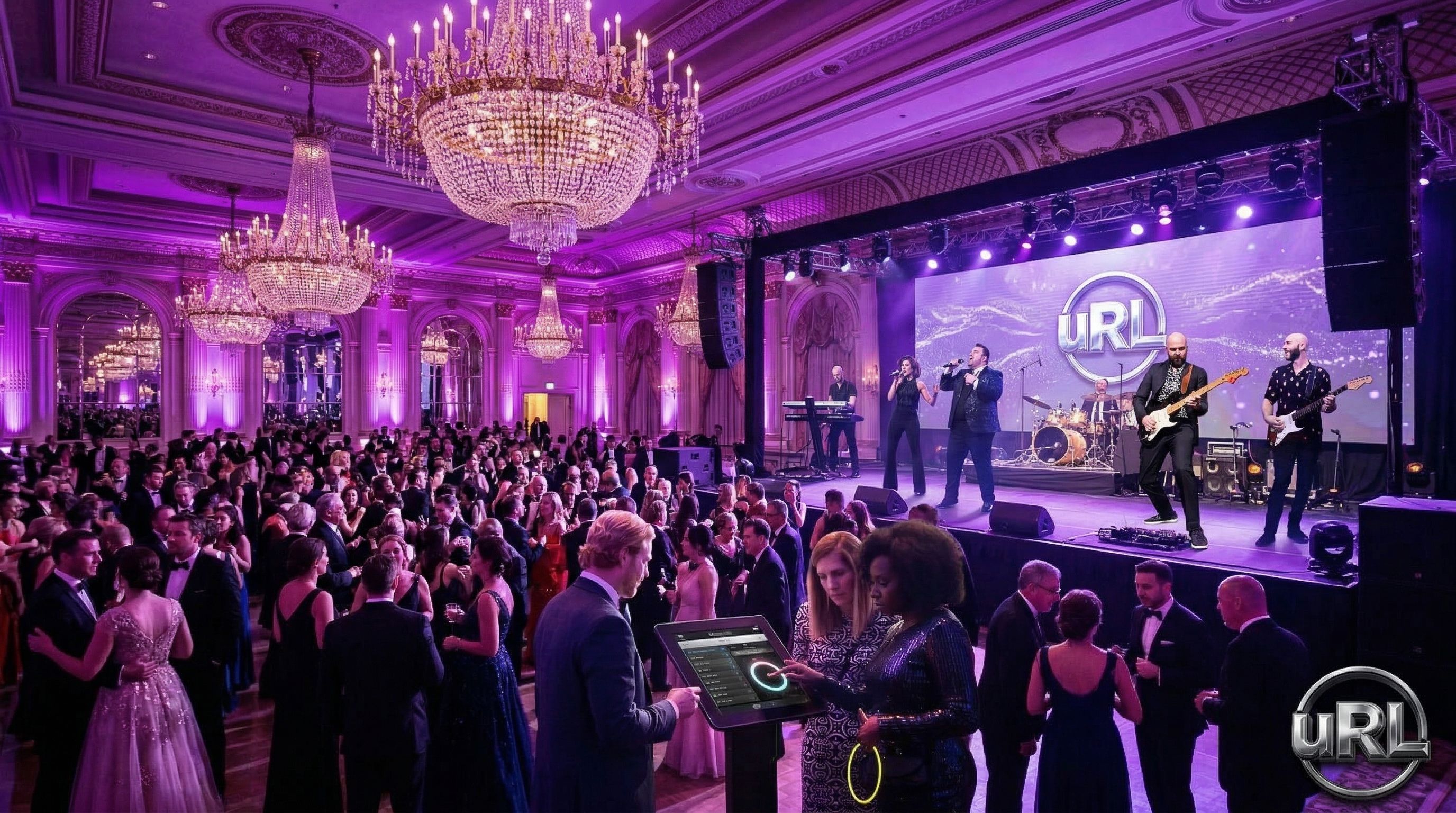
Planning music for a 500-person gala is a different discipline than booking a band for 100. The room dynamics change. The sound requirements scale nonlinearly. The stakes are higher, the logistics more complex, and the margin for error razor thin.
I've produced music for galas ranging from 200 to 2,000 guests across venues in Toronto, Vancouver, Montreal, New York, and Las Vegas. This is the framework I use every time — and the one I wish someone had given me before my first large-scale event.
Phase 1: Map Your Event Timeline to Music Zones
A 500-person gala isn't one event. It's four or five distinct events stitched together. Each phase has different musical requirements.
Cocktail Reception (60-90 minutes)
This is the warm-up. Guests arrive, find their tables, network, grab drinks. Music should be present but not demanding — a jazz trio, acoustic duo, or curated playlist at 65-72 dB. The goal is ambiance, not attention. If guests have to raise their voices to converse, you're too loud.
Dinner Service (60-75 minutes)
Slightly more energy than cocktails, but still conversational. If using a live ensemble, this is where the full band can play softly — light jazz standards, Motown instrumentals, classic soul at medium volume. Pro tip: coordinate with the catering team on service timing. No one should be hearing the climax of "Bohemian Rhapsody" while the server is asking about their entre choice.
Program & Speeches (30-45 minutes)
Music stops for speeches and awards. But walk-on and walk-off music matters more than most planners realize. A 10-second musical sting as an award winner approaches the podium adds gravitas. A subtle music bed under a video presentation enhances emotional impact. Work with your band or DJ to pre-program these cues.
Dance Party (90-120 minutes)
This is your main event. Full band, full energy, 85-95 dB. This is where song request technology becomes essential — 500 people have wildly different musical preferences, and a pre-set playlist will leave most of them cold.
Critical Detail: The transition from speeches to dance party is the make-or-break moment. You have about 90 seconds after the last speaker leaves the podium to shift the room's energy. Have your band ready with a high-impact opener — something everyone recognizes immediately.
Phase 2: Sound System Specifications
A 500-person venue requires professional-grade sound. This isn't a "bring your own PA" situation. Here's what proper coverage looks like:
Main PA system: Line array speakers flanking the stage, angled to cover the full room with even distribution. For a standard ballroom (8,000-12,000 sq ft), you need a minimum of 4,000-6,000 watts of amplification across mains and subs.
Delay speakers: For rooms deeper than 80 feet, you need delay speakers at the midpoint to prevent sound drop-off in the back third of the room. Without these, rear tables get a muddy, echo-heavy experience.
Monitor system: Stage monitors or in-ear systems for the band. At larger events, poor monitoring leads to bad performances — musicians who can't hear themselves play differently (and worse).
Separate speech system: A podium mic feeding a dedicated zone or the main PA with preset EQ for spoken word. Nothing kills momentum like the band's microphone squealing during the CEO's welcome address.
Phase 3: Band Selection and Sizing
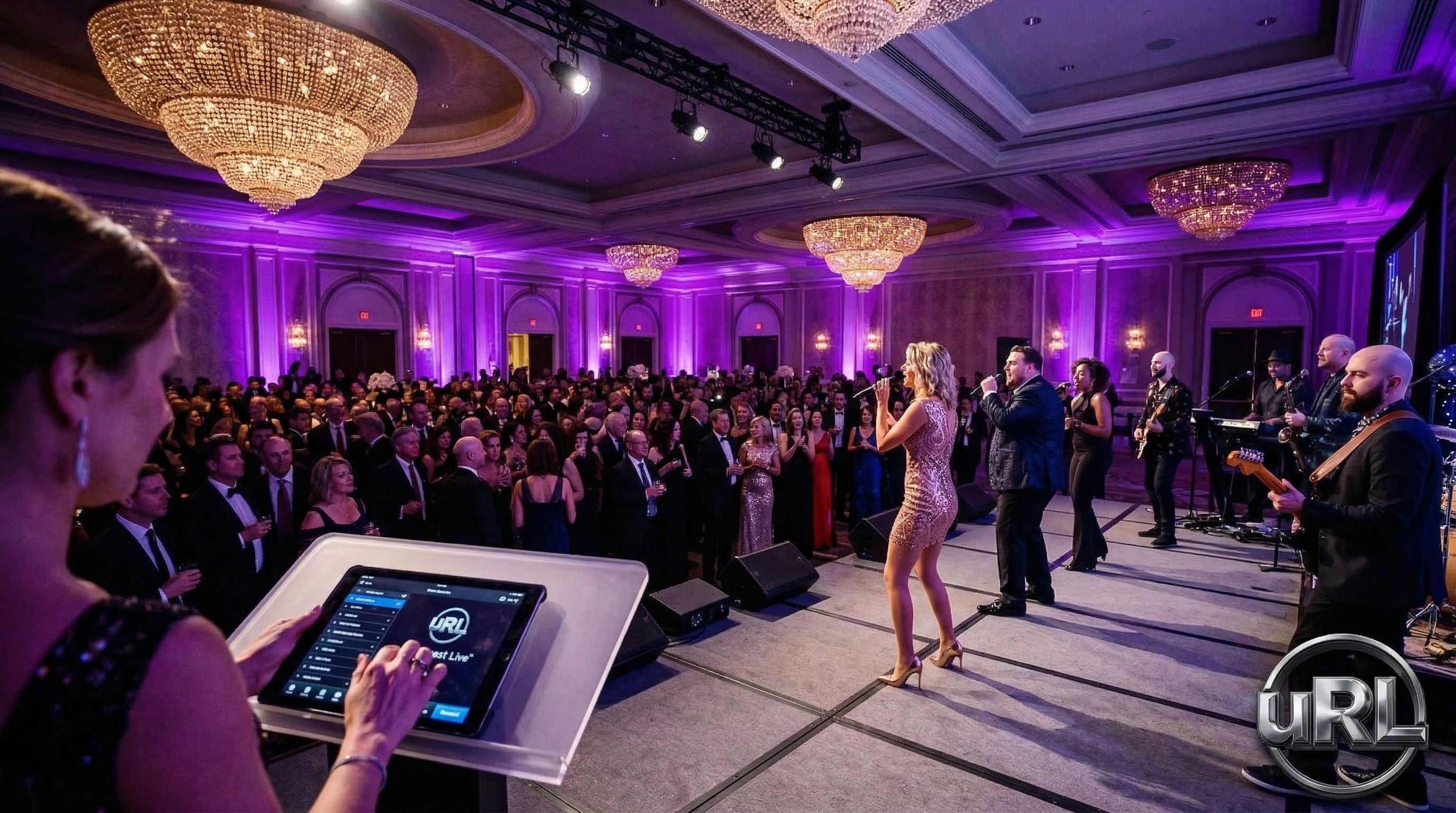
For 500 guests, the visual presence of the band matters almost as much as the sound. A three-piece rock band on a 40-foot stage looks anemic. You need enough bodies to fill the performance space and match the scale of the event.
The sweet spot for a 500-person gala is a 7-10 piece band: lead vocals, guitar, bass, drums, keys, 2-3 horns, and potentially a backup vocalist. This configuration delivers the sonic fullness and visual spectacle that large events demand.
Beyond size, look for bands that can handle the multi-phase nature of a gala. Can they play a sophisticated jazz set during cocktails AND bring the energy for a late-night dance party? Can they shift genres seamlessly? Do they have the repertoire depth to handle real-time requests from 500 people?
Phase 4: The Dance Floor Equation
Here's the math most planners get wrong:
Standard guidance says 4.5 square feet per dancer. At peak dance time, 40-60% of a 500-person crowd will be on the floor. That's 200-300 dancers needing 900-1,350 square feet of dance space.
But here's the nuance: slightly undersized is better than oversized. A dance floor at 85% capacity feels electric. A dance floor at 50% capacity feels like a middle school slow dance. Plan for the lower estimate and let the energy build naturally.
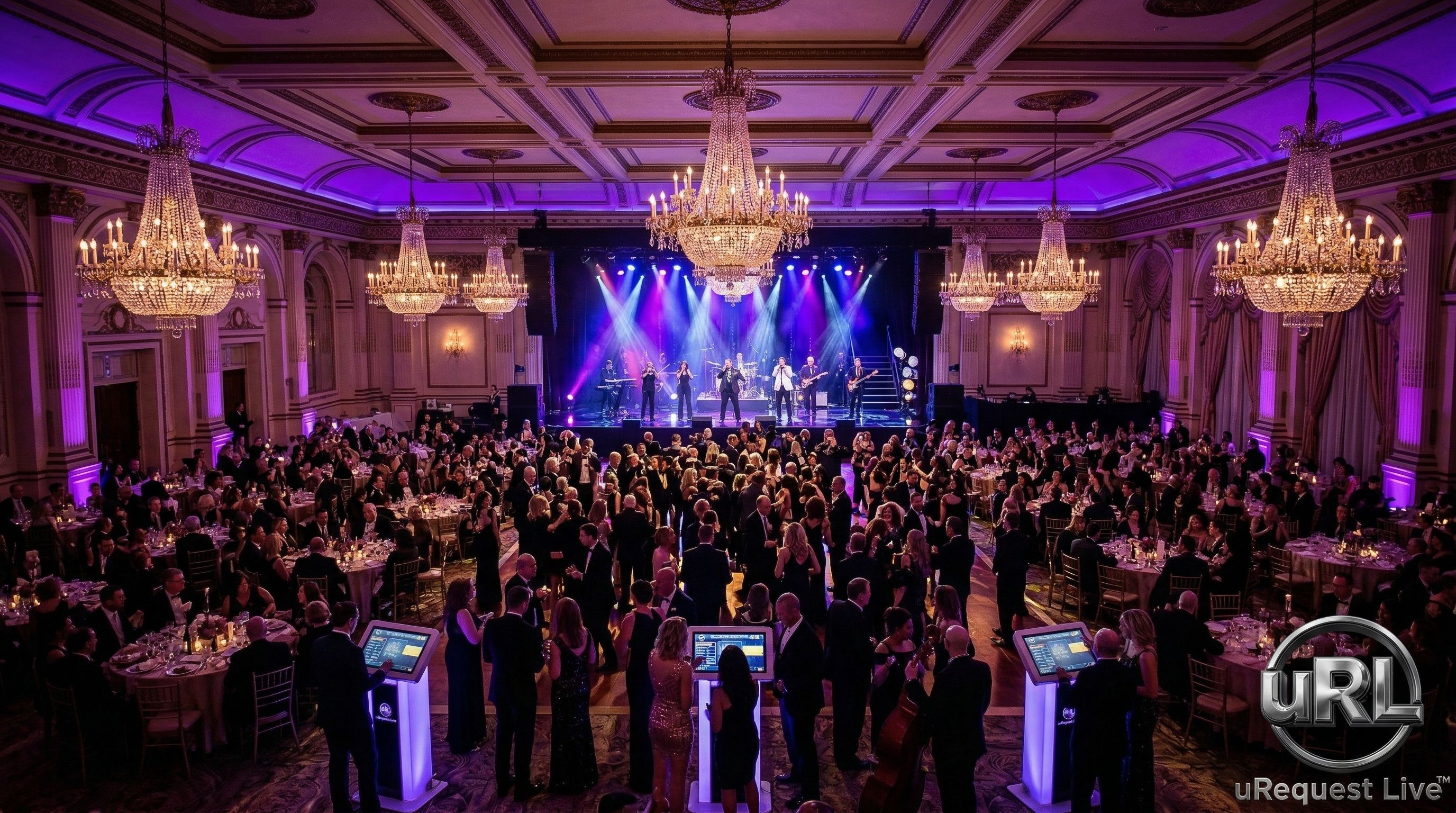
Position the dance floor between the stage and the first row of tables. Guests should be able to transition from seated to dancing without navigating an obstacle course of chairs, AV cables, and serving stations.
Phase 5: Day-Of Production Timeline
For a gala with a 7:00 PM start:
12:00 PM — Sound company load-in begins. PA installation, speaker placement, cable runs.
2:00 PM — Band load-in. Backline setup, instrument check.
3:00 PM — Sound check. Every microphone, every instrument, every transition cue. Full rehearsal of the speech-to-dance transition.
4:30 PM — Lighting check. Coordinate with the lighting designer for stage washes, dance floor effects, and spotlights.
5:30 PM — Final walkthrough with event coordinator. Confirm all cues, timing, and contingencies.
6:30 PM — Doors open. Background music begins.
Veteran Move: Always schedule sound check 3+ hours before doors. At 500-person venues, catering and decor teams are working simultaneously. If sound check runs late, you're competing with rolling carts and vacuum cleaners for stage time.
Phase 6: Contingency Planning
At scale, things go wrong. A power outage during the keynote. A singer losing their voice mid-set. The dance floor clearing because the playlist drifted into obscure territory. Here's what professional bands prepare for:
Technical failure: Professional outfits carry backup microphones, DI boxes, and cables. The sound company should have a redundant amplifier chain. Ask about this before you book.
Energy drops: This is where interactive bands have a massive advantage. If the floor thins, the band can see real-time request data and pivot to whatever the audience is actually asking for, rather than guessing. With our platform, the band always has a pulse on the room.
Schedule shifts: Speeches run long. Dinner runs late. Your entertainment must be flexible enough to compress or extend sets on the fly. Build 15-20 minutes of buffer into your timeline.
The difference between a good gala and a great one usually comes down to preparation. Every minute spent on pre-production saves five minutes of problem-solving on the night of. Plan meticulously, hire professionals who've done this at scale, and give them the tools to read and respond to your audience in real time.
Frequently Asked Questions
How loud should music be at a 500-person corporate gala?
During dinner and cocktails, 65-75 dB — audible but allowing easy conversation. During the dance segment, 85-95 dB is the sweet spot. Professional sound engineers use SPL meters throughout the event to maintain optimal levels.
How far in advance should you book entertainment for a 500-person gala?
Book 6-12 months in advance. Premium interactive bands often book 8-10 months out for peak seasons. The earlier you book, the more flexibility you have for technical coordination.
What size band do you need for 500 guests?
A 7-10 piece band is ideal. This includes vocals, guitar, bass, drums, keys, and 2-3 horn players. The visual impact of a larger ensemble matches the scale of the event.
How do you handle sound for a gala with speeches and live music?
Use separate audio zones or a single system with preset configurations. The sound engineer should have pre-programmed settings for speeches, dinner music, and dance music. Transitions between modes should be rehearsed during sound check.
What's the ideal dance floor size for 500 guests?
Plan for 900-1,350 square feet — roughly 30x35 feet to 35x40 feet. Err slightly smaller to create energy density. A dance floor at 85% capacity feels more alive than one at 50%.
Planning a Large-Scale Gala?
We've produced music for events from 200 to 2,000 guests. Let us help you get the details right.
Start Planning Your GalaArthur Kerekes
Head of Client Experience at uRequest Live
Arthur has spent over a decade in live entertainment, working with corporate clients across North America to create unforgettable event experiences. He leads client strategy at uRequest Live, where data-driven song selection meets world-class live performance.
Related Articles
The Complete Corporate Event Entertainment Timeline
Month-by-month planning guide for corporate entertainment.
What Makes a Great Corporate Event Band?
Expert breakdown of what separates good from exceptional.
Top 10 Songs for Corporate Events in 2026
The crowd-tested songs that actually pack dance floors.