
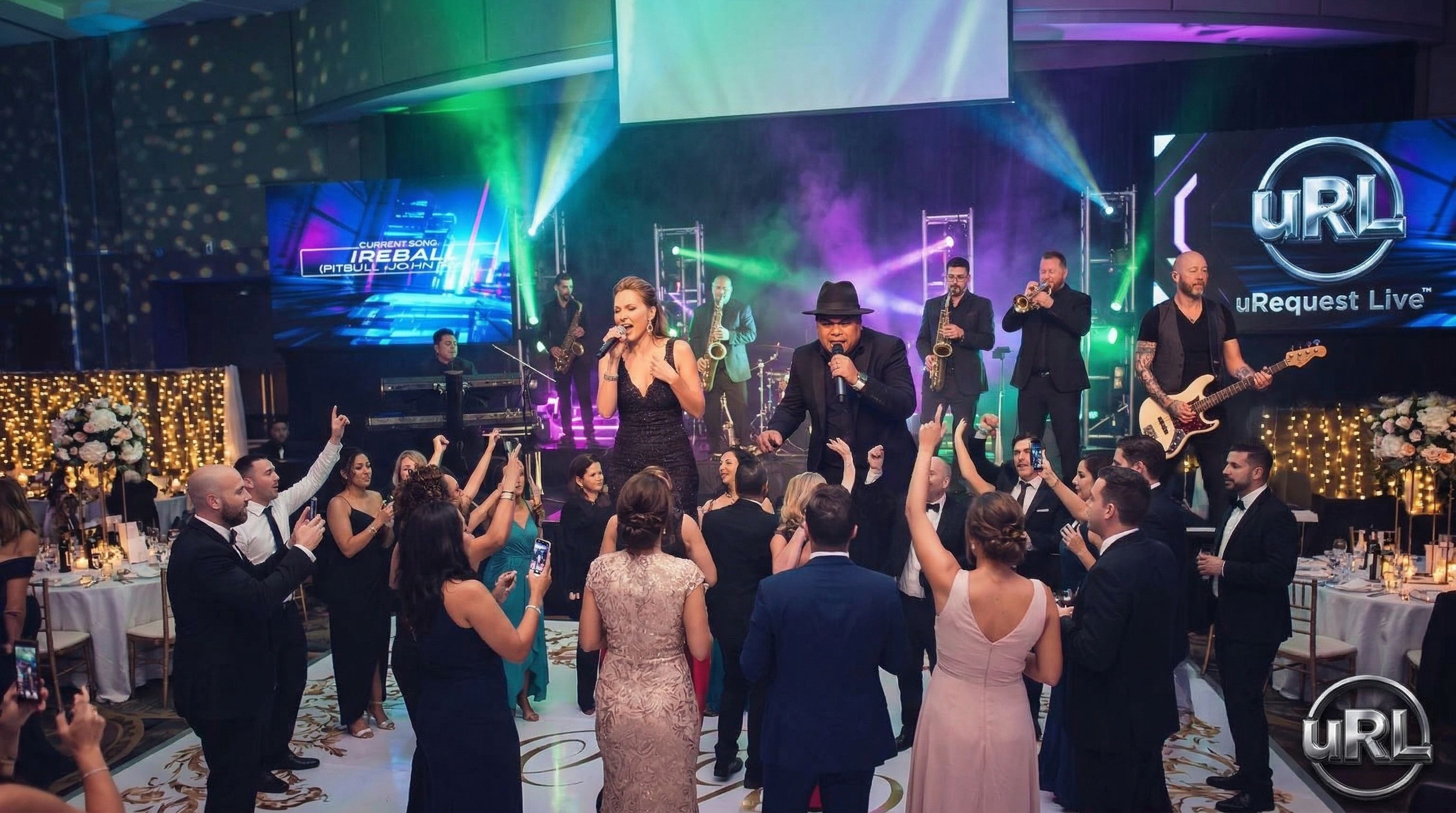
This is the question that launches a thousand wedding planning arguments. Band or DJ? Your maid of honor says one thing, your future mother-in-law says another, and every Google search gives you the same wishy-washy "it depends" answer.
So let's skip the fence-sitting. After coordinating entertainment for hundreds of Toronto weddings — working alongside both incredible bands and exceptional DJs — here's the genuinely honest breakdown. No agenda, no sales pitch. Just the truth about what each option actually delivers on your wedding day.
The Case for a Wedding Band
The Energy Is Unmatched
There's something about live music that a speaker system simply cannot replicate. When a vocalist locks eyes with the crowd during the chorus of "September" and the drummer kicks into high gear, the room vibrates differently. People respond to human performers in a way they don't respond to tracks — it's primal, it's instinctive, and it fills dance floors.
We've measured this. At weddings with live bands, the dance floor stays consistently fuller 20-30 minutes longer than DJ-only receptions. The energy builds because the musicians feed off the crowd, and the crowd feeds off the musicians. It's a feedback loop that a playlist can't create.
Visual Spectacle
A band is a performance. It gives guests something to watch even when they're not dancing. The saxophone player stepping to the front for a solo, the lead singer working the crowd, the drummer grinning during a fill — these become moments in your wedding photos and videos that a DJ booth never will.
Spontaneity and Adaptation
A great band reads the room and pivots. If the crowd is vibing on Motown, they lean into it. If the energy dips, they know how to bring it back with a well-timed transition. This real-time musical conversation between performers and audience is what separates good wedding entertainment from great wedding entertainment.
Add song request technology to the mix, and you get the ultimate adaptive experience — the band responds to what the crowd is literally voting for in real time.
The Honest Downsides of a Band
Let's be real about the limitations:
- Cost: A quality wedding band in Toronto costs $5,000-$12,000. That's a significant line item in any budget.
- Song accuracy: A band will never sound exactly like the recording. Some couples find this charming; others find it frustrating.
- Space requirements: A 6-piece band needs stage space, power, and room for equipment. Not every venue accommodates this easily.
- Breaks: Musicians need breaks. That means either 15-20 minute gaps in the music or pre-recorded tracks during downtime.
- Limited catalogue: Even great bands have a finite song list. If your must-play list includes 80 songs across 5 decades, a DJ has the advantage.
The Case for a DJ
Unlimited Music Library
A DJ can play literally any song ever recorded. That obscure Bollywood track your aunt loves? Done. The 2024 K-pop hit your cousin is obsessed with? No problem. The Frank Sinatra deep cut your grandfather danced to at his own wedding? Absolutely. No band, no matter how versatile, can match this breadth.
Budget-Friendly
A professional Toronto wedding DJ runs $1,500-$4,000 — roughly half to a third of what a band costs. For couples allocating a larger share of budget to venue, catering, or photography, a DJ delivers solid entertainment at a more accessible price point.
Consistent Volume and Sound
DJs have precise control over volume levels. Need soft background music during dinner that seamlessly transitions to dance floor energy? A DJ can do this with a fader. Bands can too, but there's inherently more variation in live performance volume.
Compact Setup
A DJ needs a table, speakers, and a small footprint. For venues with limited space — think rooftop terraces, restaurants, or intimate loft spaces — this matters.
The Honest Downsides of a DJ
- Energy ceiling: Even the best DJ has a harder time generating the raw, visceral energy of live performers. The crowd-to-performer connection is mediated by technology.
- Visual interest: A person behind a laptop isn't visually compelling. Some DJs compensate with lighting rigs, but it's still fundamentally one person and equipment.
- The "wedding DJ" stigma: We've all been to the wedding where the DJ talks too much, uses a cheesy voice, or plays the Macarena unprompted. Quality varies enormously in this space.
- Passive experience: Guests listen to a DJ; they engage with a band. This distinction matters for dance floor participation.
The Comparison Nobody Makes: Guest Engagement
Here's what most band-vs-DJ articles miss entirely. The real question isn't "which sounds better?" — it's "which creates more engagement?"
Think about your last wedding experience. Did you spend more time on the dance floor or at your table? Were you actively participating in the entertainment, or passively listening to it?
The weddings that guests rave about for years aren't defined by whether there was a band or DJ. They're defined by how much the guests felt involved. That's why the most exciting development in wedding entertainment isn't about choosing between band and DJ — it's about interactive experiences that put guests at the center.
The Interactive Factor
Song request technology transforms any musical setup — band or DJ — from a performance into a shared experience. When guests can browse songs, vote for favorites, and see their choices played live, participation goes through the roof. We've seen weddings where 85% of guests engage with the request platform throughout the night.
The Third Option: The Hybrid Approach
More and more Toronto couples are discovering that they don't have to choose. The hybrid model combines the best elements of both:
Option A: DJ + Band (Split Night)
DJ handles cocktail hour and dinner with perfectly curated background music and unlimited song selection. The band takes over for the dance party, delivering that live energy when it matters most. This lets you control costs while still getting the band experience for the peak hours.
Option B: Band with DJ Elements
Some modern bands incorporate DJ breaks between sets — keeping the music flowing without awkward silence. The DJ plays tracks the band doesn't cover, then the band comes back with renewed energy. It's seamless when done well.
Option C: Interactive Band with Technology
This is where things get interesting. A live band equipped with real-time song request and voting technology essentially eliminates the DJ's biggest advantage (unlimited catalogue adaptability) while keeping the band's biggest advantage (live energy and visual spectacle). Guests choose the songs; the band plays them live. It's the best of every world.
Add live band karaoke where guests actually sing with the band, and you've created an experience that neither a traditional band nor a traditional DJ can match alone.
The Decision Framework
Still not sure? Run through this checklist:
Choose a Band If:
- Dance floor energy is your top priority
- You want visual entertainment and performer-crowd interaction
- Your venue has good stage space and power capacity
- Your budget allows $5,000+ for entertainment
- You value spontaneity and live musical moments
- You want guests talking about the entertainment for years
Choose a DJ If:
- Song accuracy and breadth matter most to you
- Your venue has space limitations
- Your budget prioritizes other elements
- You have a very specific, diverse must-play list
- Consistent, controlled volume is important
- You want one person handling all music + MC duties
Choose a Hybrid / Interactive Band If:
- You want the best of both worlds
- Guest participation is a priority
- You love the idea of guests singing with a live band
- You want technology-driven song selection with live performance
- You're planning a reception for 100+ guests across multiple generations
Real Talk: What Toronto Couples Actually Choose
Based on what we're seeing in the Toronto market in 2026, the trend is decisively moving toward interactive entertainment. Couples who grew up with Spotify and social media expect participation, not passive consumption. They want their guests to shape the experience.
The traditional band-vs-DJ debate is becoming less relevant as the lines blur. The most memorable weddings we've been part of recently weren't defined by "band" or "DJ" — they were defined by how much guests were part of the music.
Whatever you choose, the right entertainment provider will ask you detailed questions about your vision, your guest demographics, your venue, and your priorities. If someone just sends you a price sheet without asking questions, keep looking.
Not Sure What's Right for Your Wedding?
We'll help you figure out the perfect entertainment setup for your venue, budget, and vision.
Frequently Asked Questions
Is a wedding band or DJ better for a small wedding?
For intimate weddings under 80 guests, a small acoustic band (2-3 musicians) creates warm, personal atmosphere. DJs work well too, but volume management is crucial. The deciding factor is atmosphere — bands add organic warmth, DJs offer variety.
Can you have both a band and a DJ at a wedding?
Yes, and this hybrid approach is increasingly popular. A common setup: DJ handles cocktail hour, then the band takes over for dancing. Some bands incorporate DJ elements between sets for seamless music throughout the night.
How much more does a wedding band cost than a DJ?
In Toronto, a professional DJ typically costs $1,500-$4,000 while a band ranges from $3,000-$15,000+. A band is generally 2-4x the cost of a DJ, though interactive bands with technology deliver a fundamentally different experience.
Will a wedding band play songs exactly like the original?
Not exactly, and that's the point. Great bands put their own energy into songs, creating unique live moments. If you want songs to sound exactly like recordings, a DJ is the better choice.