
The Evolution of Event Entertainment: From DJs to Interactive Bands
A thought leadership piece tracing the evolution of event entertainment from jukeboxes to AI-powered interactive bands. Where the industry has been, where it's going, and why interactivity is the future.
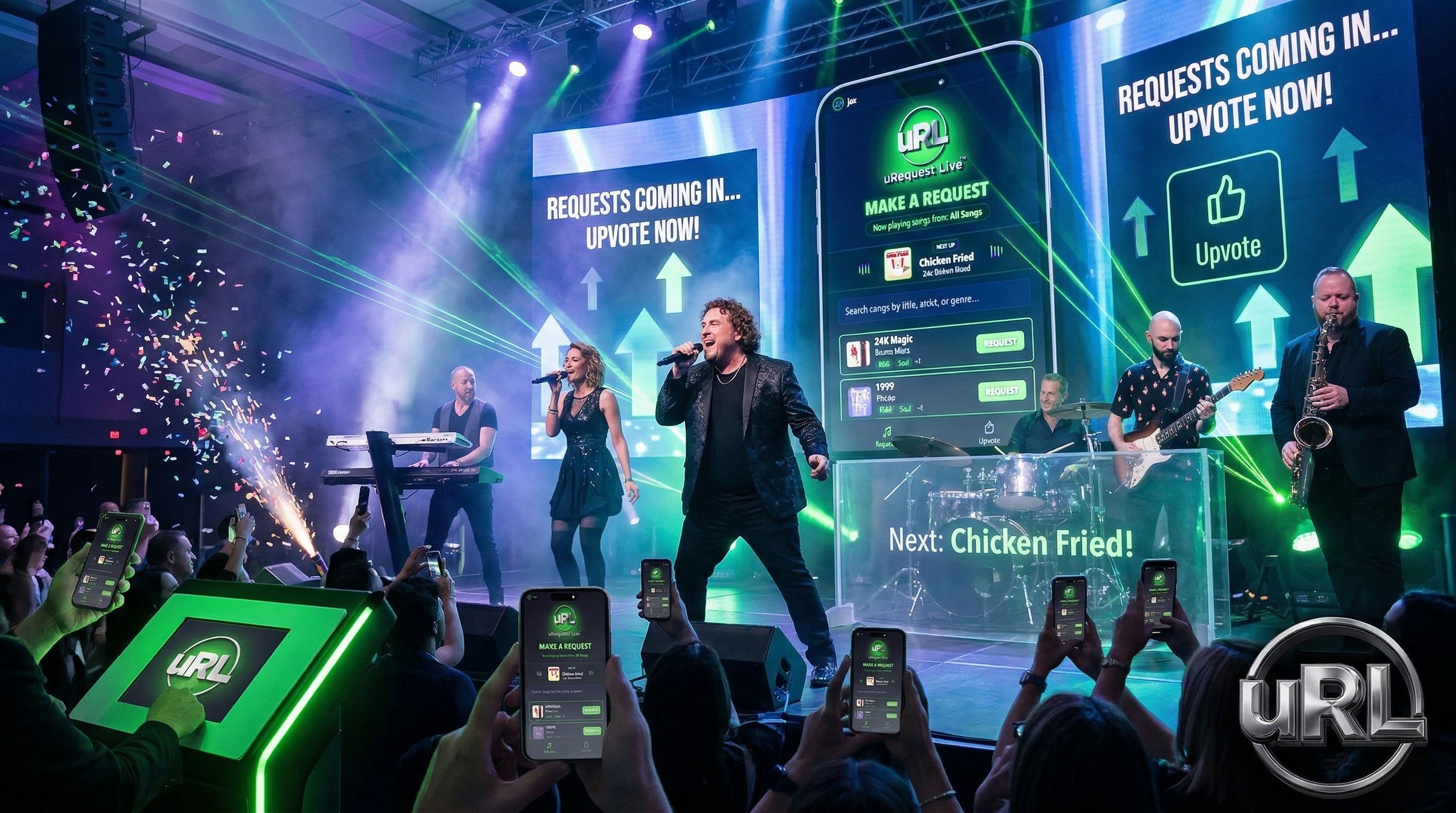
In 1950, if you wanted music at your corporate dinner, you hired a pianist. In 1980, you hired a cover band. In 2000, you hired a DJ. In 2025, you hire an interactive band that lets your guests choose the music in real time while AI analytics track crowd energy and optimize the experience on the fly.
The story of event entertainment is the story of a slow-motion revolution — from passive consumption to active participation, from one-size-fits-all to personalized, from performance to experience. Understanding this arc isn't just interesting history. It's the roadmap for where the industry is heading next.
The Jukebox Era: The First Taste of Choice (1940s-1960s)
Before DJs existed as a profession, the jukebox was the closest thing to interactive music. Put in a quarter, pick a song, and for three minutes, the room was listening to your choice. It was primitive by today's standards, but the psychological principle was already there: people want agency over their musical experience.
Corporate events during this era were formal affairs — big band orchestras at hotel ballrooms, dress codes enforced with the rigidity of a military inspection. The entertainment was impressive but wholly passive. You sat. You listened. You clapped politely. The idea that a guest might influence what the band played would have been considered absurd.
The DJ Revolution: Democratizing the Dance Floor (1970s-1990s)
The rise of the mobile DJ fundamentally changed event entertainment. Suddenly, a single person with a record collection and a sound system could provide five hours of continuous, diverse music at a fraction of a band's cost. DJs could read a room, adjust on the fly, and access a music catalog no band could match.
DJs also introduced something subtle but important: the idea of the dance floor as a feedback loop. Good DJs watched the crowd and adjusted. When people danced, the DJ played more of that genre. When the floor emptied, the DJ pivoted. It wasn't true audience interaction, but it was responsive entertainment — a crucial step in the evolution.
The Limitations of the DJ Model
For all their flexibility, DJs hit a ceiling that the industry has spent decades trying to break through: the emotional ceiling. Recorded music, no matter how well-mixed, lacks the visceral impact of live performance. A DJ playing "Bohemian Rhapsody" and a band performing it are fundamentally different experiences. The notes are the same; the energy is not.
The Cover Band Era: Energy Without Flexibility (1990s-2010s)
Cover bands brought live energy back to events but introduced their own limitation: the setlist. A band rehearses 40-60 songs and plays them in roughly the same order at every event. The energy is real, but the personalization is minimal. Band A plays the same songs at Wedding A and Corporate Event B, regardless of who's in the room.
Some bands took requests by having guests approach the stage — a socially awkward process that favored extroverts and excluded anyone who wasn't comfortable interrupting a performance. The request was verbal, unstructured, and often ignored because the band didn't know the song.
The Interactive Era: Technology Meets Performance (2015-Present)
The convergence of smartphones, real-time web technology, and professional live performance created something genuinely new: the interactive band. For the first time, every person in the room could influence the entertainment without leaving their seat, approaching the stage, or shouting over the music.
Song request platforms gave audiences democratic power over the setlist. Voting systems created social dynamics and anticipation. Real-time data gave bands unprecedented insight into what their specific audience wanted, in that specific moment.
This wasn't just a technological upgrade — it was a paradigm shift. The relationship between performer and audience changed from broadcast (one-to-many) to dialogue (many-to-many, mediated by the band). The band became a facilitator of the crowd's collective musical vision, not just an entertainer playing at them.
The engagement evolution in numbers:
- Jukebox era: 1 person choosing per song
- DJ era: 0 people choosing (DJ reads the room indirectly)
- Cover band era: 2-5 people brave enough to request per event
- Interactive band era: 60-80% of audience actively participating
What's Driving the Shift to Interactivity
The Participation Economy
We live in an era where people create TikToks, not home videos. They post Instagram stories, not photo albums. They stream on Twitch, not just watch TV. The expectation of participation has permeated every form of media and entertainment. Events that don't offer participation feel increasingly outdated.
The Personalization Expectation
Netflix recommends shows. Spotify creates personalized playlists. Amazon suggests products. Every digital experience your guests encounter daily is personalized to their preferences. When they attend an event where the entertainment ignores their preferences entirely, the contrast is jarring — even if they can't articulate why.
The Experience Economy Maturity
Pine and Gilmore's "Experience Economy" thesis from 1998 has fully matured. Consumers — and by extension, event attendees — value experiences over products and services. But within the experience economy, participatory experiences command the highest premium. You can watch a concert, or you can influence the setlist. The latter is worth more.
Where We're Headed: The Next Decade
AI-Enhanced Live Performance
Artificial intelligence won't replace live musicians (the uncanny valley for musical performance is deep and wide). But AI will enhance their ability to serve audiences. Real-time sentiment analysis from crowd reactions. Predictive algorithms that suggest optimal setlist order. Dynamic lighting and visual effects that respond to crowd energy. The musician's artistry, amplified by data.
Hyper-Personalized Event Soundtracks
Imagine an event where the song request system knows the musical preferences of each attendee (from pre-event surveys or integrated Spotify data) and weights voting accordingly. The 200-person event doesn't just play crowd favorites — it plays the specific crowd's favorites, with an algorithm that ensures every demographic in the room is represented.
The Blurring of Virtual and Physical
Hybrid events with both in-person and remote attendees will demand entertainment that works across both modalities. Interactive music technology is inherently suited to this — the request interface works identically whether you're in the ballroom or on your couch. Live-streamed performances with real-time voting from both populations create truly unified hybrid experiences.
The Constant: Human Connection
Through every era and every technological shift, one thing hasn't changed: people attend events to connect with other people. Technology is the means, not the end. The best interactive entertainment uses technology to lower barriers, increase participation, and create shared moments — but the moments themselves are profoundly human.
The band that plays your song isn't a technology experience. It's an emotional one. The technology just made sure they knew what to play.
Experience the Future of Event Entertainment
See how interactive technology and live performance create something entirely new.
Learn MoreFrequently Asked Questions
How has event entertainment changed over the decades?
Event entertainment has evolved from passive formats (jukeboxes, DJs playing setlists) to increasingly interactive experiences. The trend line is clear: audiences expect to be participants, not just spectators.
What is an interactive band?
An interactive band combines professional live musicians with audience participation technology. Guests use their smartphones to request and vote on songs in real-time, and the band performs the crowd's choices live.
Are DJs being replaced by interactive bands?
Not replaced, but augmented. DJs remain excellent for certain event formats. However, for events where engagement and participation are priorities, interactive bands offer something DJs can't: the emotional connection of live performance combined with democratic audience input.
What role will AI play in the future of event entertainment?
AI will enhance rather than replace live entertainment. Real-time sentiment analysis, predictive song selection, and dynamic lighting synchronized to crowd energy are all emerging applications. The human elements remain irreplaceable.