
Behind the Scenes: How uRequest Live Runs a Show
A personal look behind the curtain from founder Arthur Kerekes. What actually happens from load-in to last song, and the invisible systems that make 300 people think the band is reading their minds.
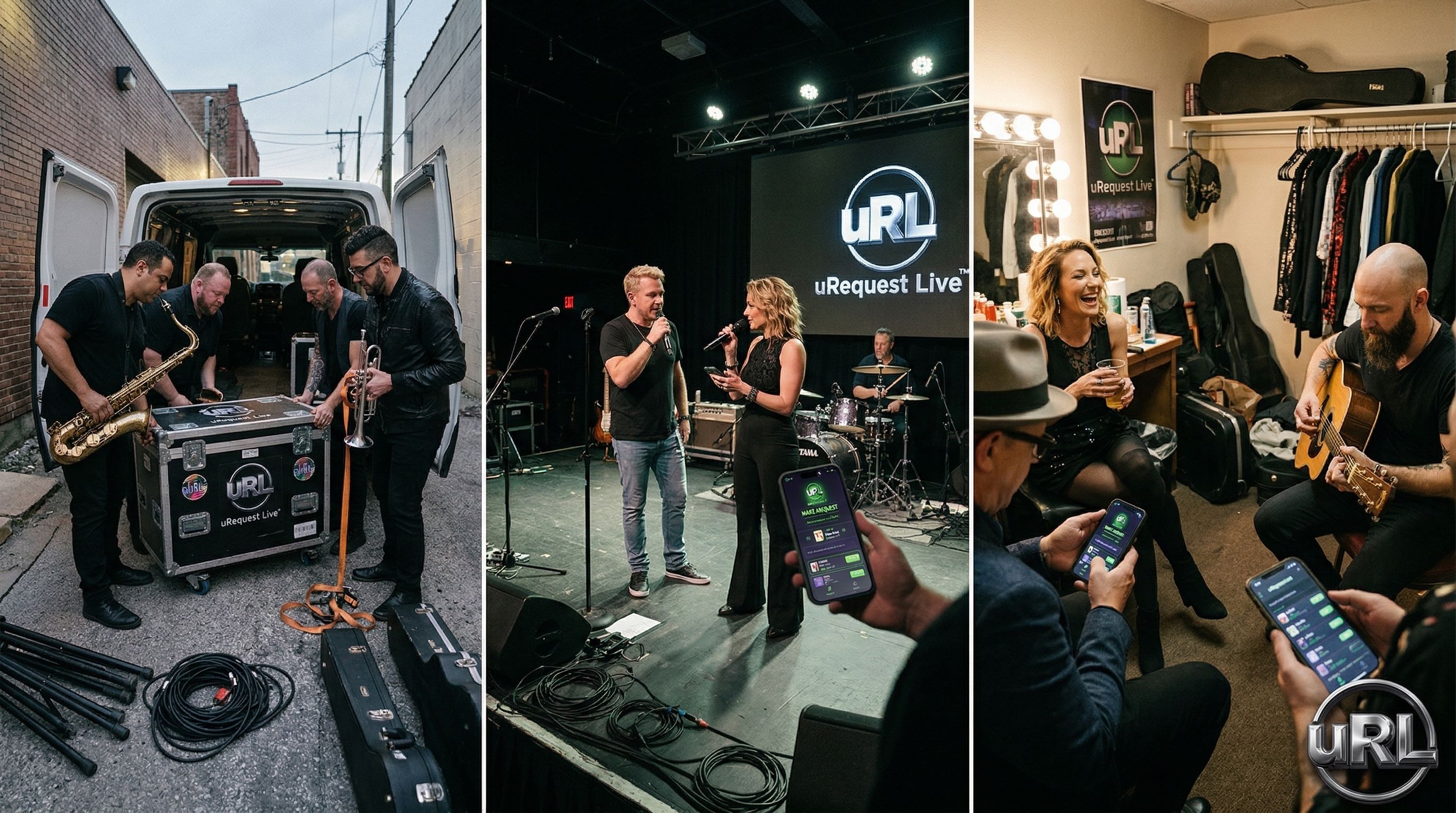
I'm writing this at 2:47 AM. We just wrapped a 400-person corporate gala at the Fairmont Royal York in Toronto. My ears are still ringing slightly — occupational hazard — and I'm running on the specific type of adrenaline that only comes from watching a room of strangers become a community over the course of three hours.
People see the show. They see the lights, hear the music, feel the energy. What they don't see is the invisible machinery that makes it all work — the fourteen hours of preparation that precede three hours of performance, the technology humming in the background, the split-second decisions that nobody in the audience ever notices.
I want to pull back the curtain. Here's what actually happens when uRequest Live runs a show.
T-Minus 14 Hours: The Pre-Game
My day started at noon with what I call "the homework." Every show starts with a review of the client brief: who's in the room, what's the occasion, what are the must-plays, what are the landmines to avoid. Tonight's client is a financial services firm celebrating their 25th anniversary. Mixed age range (23-62), C-suite will be present, three award presentations during the evening, and the CEO specifically requested "Don't Stop Believin'" for the finale.
I review the curated song library we built for this event. 647 songs spanning six decades — everything from Frank Sinatra to Dua Lipa, with the explicit content and anything too niche filtered out. This library was approved by the event planner two weeks ago, but I always do a final review. Tonight I'm adding a few financial industry inside jokes to the library: "Money Money Money" by ABBA, "For the Love of Money" by The O'Jays. Small touches, but they'll get a reaction.
T-Minus 5 Hours: Load-In
The venue's loading dock smells like every loading dock everywhere — diesel and concrete. Our gear truck backs in at 3 PM sharp. What follows is a choreography that my team has performed hundreds of times:
- Drums and hardware first (they take the longest to set up)
- PA system and monitors next (the sound engineer needs maximum testing time)
- Guitars, bass, keys — positioned and connected
- Lighting rigs focused and programmed
- Technology station: the nerve center where our request platform runs
The tech station is my baby. Two tablets showing the request dashboard. A backup laptop running the offline failover system. A dedicated mobile hotspot (we never rely on venue WiFi). And the QR code cards — 40 of them, one for every table — each linking to tonight's custom event page.
T-Minus 2 Hours: Soundcheck and Tech Test
Soundcheck isn't just about volume levels. It's about the room. Every venue sounds different — the Fairmont ballroom has high ceilings with ornate plasterwork that creates specific reflection patterns. Our sound engineer walks the room with a measurement mic, checking frequency response from every angle. The couple at table 27 in the back corner should hear the same clarity as the people on the dance floor.
Simultaneously, I'm testing the request platform. I submit test requests from three different phones, verify the voting system updates in real-time, confirm the band dashboard is receiving data with zero lag, and test the QR codes on the actual table cards. Then I break it on purpose — kill the WiFi, switch to cellular, verify the failover works. I've done this a thousand times and I test it every single time.
The Band Huddle
Twenty minutes before doors open, we huddle. I share the intel: "Financial services company, 25th anniversary, average age probably mid-40s but there are some younger analysts. Three awards between 8:15 and 8:45 — we need to be ready for walk-up music. CEO wants Journey to close. The event planner says the company culture is 'buttoned-up but ready to party.' Let's start refined and let them tell us when to turn it up."
The band nods. These are seasoned musicians who've played hundreds of corporate events. They know what "buttoned-up but ready to party" means: start with sophisticated grooves, read the room, and have the Bon Jovi ready for when the ties come off.
Showtime: The Invisible Dashboard
Doors opened at 6 PM. By 6:15, the first requests are coming in. I'm watching the dashboard from my position near the tech station, and the data is already telling me things:
The first ten requests are split between classic rock (older crowd arriving early) and current pop (younger staff showing up). Good — the library balance is right. Three people have already voted for "September" by Earth, Wind & Fire, and we're not even on stage yet. That's going to be a moment.
The First Set: Testing the Water
We open with a mid-tempo groove — "Superstition" by Stevie Wonder. Safe, universally loved, and it lets me gauge the room's response. From the stage, I can see about 30% of the room watching us, 20% actively engaged (tapping, moving), and the rest still networking. That's normal for an opening number at a dinner event.
The dashboard shows 89 active users on the platform — about 22% of the room — and we've been live for four songs. That number will climb. By the end of the night, we'll typically hit 70-80%.
The Request Flow
Here's what the audience doesn't see: I'm making setlist decisions every three minutes based on a combination of vote data and instinct. The top-voted song right now is "Uptown Funk" with 34 votes. But we just played a high-energy funk number. If I play another one immediately, we'll peak too early. So I look at the number-two request — "Don't Stop" by Fleetwood Mac, 28 votes — and that's a better energy bridge.
I queue Fleetwood Mac, and while we play it, "Uptown Funk" climbs to 47 votes. By the time we get to it two songs later, the anticipation has built, and when the first bass note drops, the dance floor explodes. The delay wasn't a mistake — it was strategic anticipation management, and the crowd doesn't realize they were being expertly managed. They just know the band "nailed it."
The Awards Interlude
At 8:12 PM, I get the signal from the event planner: awards in three minutes. We wrap the current song and transition to ambient background. During each award, I'm pre-loading walk-up music — personalized songs the event planner shared with us for each winner. When Sarah Chen's name is announced for Employee of the Year, the band launches into her walk-up pick: "Confident" by Demi Lovato. She lights up. Her table goes wild. That fifteen seconds of personalized music makes her feel like a rock star, and it cost us nothing but preparation.
The Final Hour: When the Room Takes Over
By 10 PM, the dashboard shows 312 unique users — 78% of the room has interacted with the platform. The request queue is 40+ songs deep, which means we're in the position every interactive band wants: overwhelming demand. The crowd is choosing our show for us, and they don't even know it.
The energy is self-sustaining now. Every song we play was requested by someone in the room, and when it starts, you can see the reaction ripple outward from the person who requested it. They grab their friends: "That's my song!" The friends start dancing. The dance floor expands. Someone films it. The cycle feeds itself.
At 10:45, I look at the clock and signal the band: three songs left. We play the second-highest voted song of the night ("Bohemian Rhapsody" — and yes, 300 finance professionals doing the operatic section is exactly as magnificent as it sounds), then one more high-energy number, and then the CEO's request.
"Don't Stop Believin'" hits and the room goes to another level. Everyone knows this is the last song. Everyone is singing. Phones are up, filming. The CEO is in the front row, jacket off, tie loosened, belting the chorus. This is the moment. This is what we do.
T-Plus 30 Minutes: The Tear-Down
The room clears. The event planner finds me with tears in her eyes — the good kind. "That was the best event we've ever had." I hear some version of this after most shows, and it never gets old.
While I'm having that conversation, the band is already packing. Drums first, PA last. We'll be out of the venue by midnight, gear loaded, ready for the next one. Tomorrow I'll review the analytics, send the event planner a post-show report with engagement data, and start prepping for Saturday's show.
What I've Learned From a Thousand Shows
After a decade of this, a few truths have crystallized:
Technology is only as good as the humans operating it. The request platform gives us data, but a musician's instinct for the room — the ability to feel when energy is shifting, to read body language, to know when to push and when to pull back — that's irreplaceable. The best shows happen when data and instinct agree.
Every audience is different. I've played for 50-person startups and 800-person galas. Tech companies and law firms. Millennials and boomers. The approach changes every time, and if you treat any two events the same, you're doing it wrong.
The moment that matters most is the one you can't plan for. It's the spontaneous group singalong. The unexpected dance circle. The couple that slow dances to a crowd-voted ballad while 300 people quietly give them the floor. These moments emerge from the conditions you create, but they can't be scripted. And they're the ones people remember ten years later.
That's what we do. We create the conditions for magic, then get out of the way and let 300 people make it happen together.
Experience It Yourself
Words can only do so much. The best way to understand what we do is to see it live.
Book Your EventFrequently Asked Questions
What happens before a uRequest Live show?
4-5 hours of setup: load-in, soundcheck, technology testing, library configuration, and a full band briefing on the client's specific needs and audience.
How does the band decide which songs to play?
Part democracy, part curation. Top-voted songs get priority, but the band leader sequences them for optimal energy flow — data-informed artistry.
What technology powers the show?
A custom platform on redundant cloud servers. Guest-facing web app via QR code, real-time band dashboard, and analytics engine — all connected via WebSocket.
What if the technology fails?
Three layers of redundancy. Zero complete failures in 10+ years. And even without tech, we're still a world-class live band.