
Why Your Corporate Event Needs a Song Request System
Still running events without interactive entertainment technology? Here's the business case for adding a song request system to your next corporate event — and what you're leaving on the table without one.
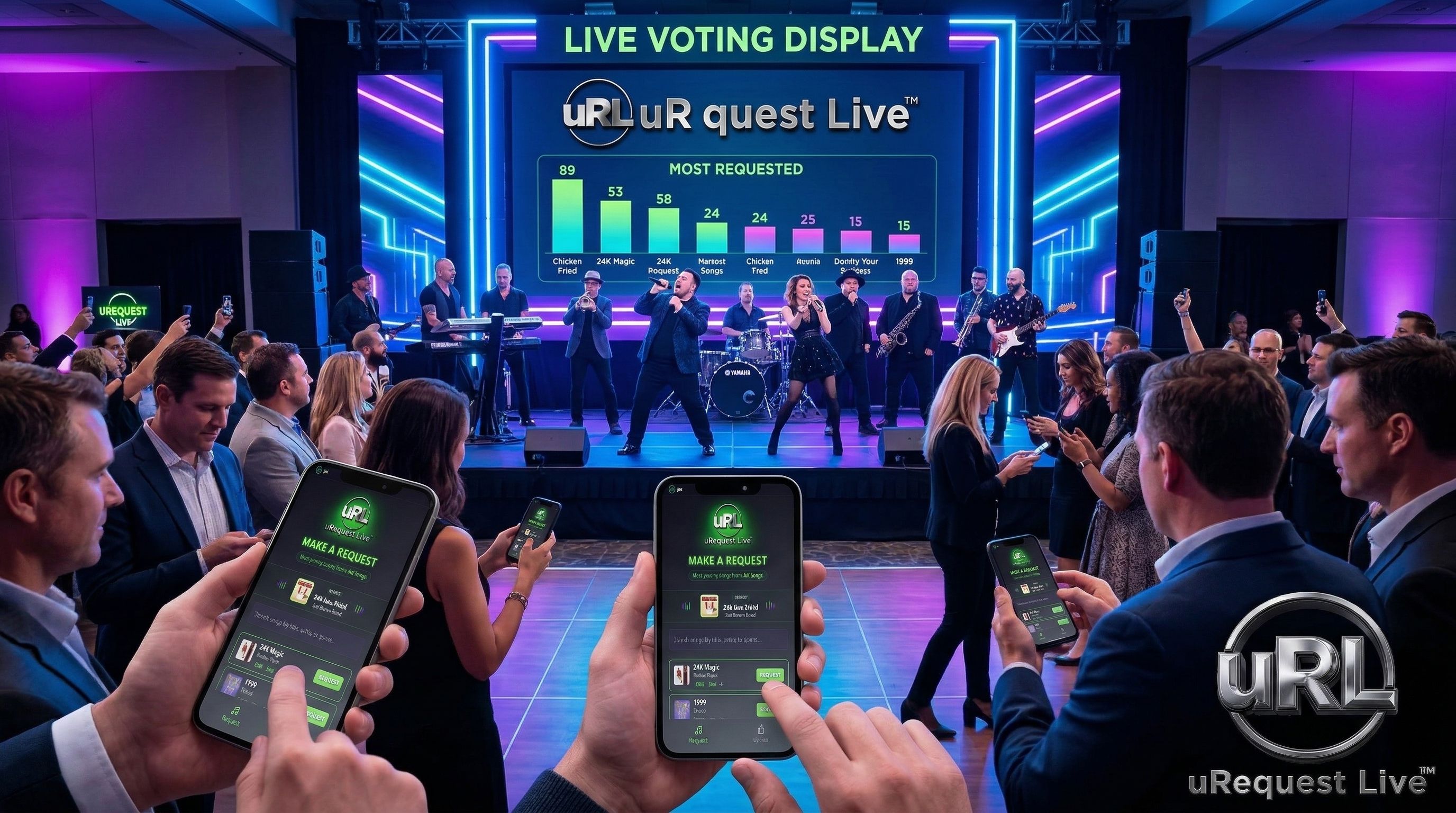
Your employees are used to Netflix recommending shows, Spotify curating playlists, and Uber knowing where they want to go. Every digital experience in their lives is personalized, responsive, and built around their preferences. Then they show up at the company gala and the entertainment is a band playing the same setlist they play at every event, to every audience, regardless of who's in the room.
There's a disconnect. And your employees feel it, even if they can't articulate it. The event feels generic because it is generic. A song request system fixes this by putting the audience's preferences at the center of the entertainment experience — exactly where your employees expect them to be.
The Five-Minute Business Case
Problem 1: Low Engagement
At a typical corporate event with standard entertainment, 30-40% of guests actively engage with the entertainment. The rest are on the periphery — socializing in separate areas, checking phones, or leaving early. A song request system increases active engagement to 65-80% because it gives every guest a reason to participate, not just the extroverts who love dancing.
Problem 2: The "Wrong Music" Risk
Even the best bands sometimes misjudge a room. They play too much classic rock for a young tech crowd, or too much current pop for a more mature audience. With a request system, this risk evaporates. The audience tells the band exactly what they want. The music is right by definition because the people in the room chose it.
Problem 3: No Post-Event Data
"How was the entertainment?" is a question that usually gets answered with anecdotes. With a request system, you get data: participation rates, peak engagement times, most popular genres, and comparative analytics across events. For planners who need to justify entertainment spend, this data is invaluable.
Problem 4: Short Event Duration
When guests don't have a reason to stay, they leave. Average departure time at events with standard entertainment is 10:15 PM. With interactive entertainment, it's 11:30 PM. Those 75 extra minutes represent more networking, more team bonding, and more return on your event investment.
Problem 5: Forgettable Experience
Most corporate events blend together in employees' memories. "Which year was that again?" Interactive events create specific, memorable moments: "Remember when Sarah from accounting got the whole room doing the Macarena?" Personal participation creates personal memories, and personal memories create lasting cultural impact.
How It Works in Practice
- Setup is invisible — QR codes on table cards, bar menus, or projected on screens. Guests scan with their phone camera. No app download, no account creation, no friction.
- Browsing is intuitive — A curated library organized by genre, decade, and mood. Search by song name or artist. Everything is mobile-optimized.
- Voting creates engagement — Guests submit requests and see real-time vote counts. Popular songs rise to the top. The social proof mechanic ("47 people also voted for this!") drives participation.
- The band delivers — Professional musicians perform the crowd's top choices live. The energy of hearing YOUR song performed live by a professional band is incomparable.
- The cycle repeats — Request, anticipate, hear, celebrate, request again. This engagement loop sustains energy throughout the evening.
Objections Addressed
"Won't people request inappropriate songs?"
The library is curated in advance. Only songs the band can actually perform, that are appropriate for the event context, appear as options. The planner approves the library beforehand.
"What if people keep requesting the same song?"
Once a song is played, it's removed from the active request pool. The system manages variety automatically.
"Does the band just play whatever gets the most votes?"
The band uses votes as a guide, not a mandate. Professional musicians maintain flow, energy, and variety while honoring the crowd's preferences. It's collaborative, not automated.
Who Benefits
- Event planners — Predictable engagement, post-event data, and reduced "will they like it?" anxiety
- HR teams — Measurably better employee event satisfaction and engagement scores
- Marketing teams — More social media content from events, stronger employer brand signals
- Attendees — An experience that feels personalized, participatory, and genuinely fun
- The band — Real-time intelligence about what the audience wants, leading to better performances
See It for Yourself
The best way to understand the impact is to experience it. Let's show you what interactive entertainment looks like.
Book a ConsultationFrequently Asked Questions
What is a song request system?
A digital platform allowing event guests to browse songs, submit requests, and vote using smartphones. The band performs the crowd's choices live.
How does it improve corporate events?
73% average participation rate, longer stay times, higher satisfaction scores, and post-event engagement data.
Is it appropriate for formal events?
Yes. The curated library adapts to any formality level, from jazz standards to full genre diversity.
How much does it cost?
At uRequest Live, interactive technology is included with every booking at no additional cost.