
Team Building Through Music: Why It Works
Forget trust falls. Music-based team building creates genuine bonds through shared emotional experiences, collaborative creativity, and the universal language of rhythm.
The $3.5 billion team building industry has a dirty secret: most team building activities don't build teams. They build resentment. The groan that echoes through an office when someone announces "mandatory fun" tells you everything you need to know about how employees feel about conventional team building.
Trust falls, escape rooms, and personality assessments have their place. But if you're looking for an experience that creates genuine emotional bonds without making anyone feel uncomfortable, awkward, or patronized — music is the answer that's been hiding in plain sight.
The Neuroscience of Musical Bonding
When people experience music together, something remarkable happens in their brains. Neuroscientist Jessica Grahn's research at Western University has shown that musical rhythm produces neural synchronization — the brainwaves of people listening to the same music literally begin to align.
This isn't metaphorical. EEG studies show measurable alignment in neural oscillation patterns when groups experience music together. This synchronization correlates with increased feelings of social bonding, trust, and cooperation. Your team's brains are literally getting on the same wavelength.
Oxytocin: The Trust Molecule
Group musical experiences trigger the release of oxytocin — often called the "bonding hormone" or "trust molecule." Research published in Frontiers in Psychology found that group singing produced oxytocin levels 4x higher than those measured after standard group conversations.
You don't need your team to sing together to get this effect (though karaoke certainly qualifies). Even shared listening experiences — particularly when combined with movement, like dancing — produce significant oxytocin increases. A dance floor is, neurochemically speaking, a trust-building exercise.
Why Traditional Team Building Often Fails
To understand why music-based team building works, it helps to understand why the alternatives often don't:
- Performance anxiety — Escape rooms and challenge-based activities create winners and losers. The pressure to perform can increase stress rather than reduce it, especially for introverts or newer team members.
- Forced vulnerability — "Share something personal about yourself" exercises feel invasive and can backfire with culturally diverse teams.
- Hierarchy reinforcement — Activities that require leadership naturally default to existing power structures. The manager leads; the junior staff follows. Nothing changes.
- Time pressure — Timed activities create urgency that works against the relaxed social interaction that actually builds relationships.
Music flips all of these dynamics. There's no performance pressure in choosing a song or dancing to one. The experience is social without being forced. Hierarchy dissolves when the VP of sales and the new hire discover they both love 90s hip-hop. And there's no clock ticking — the experience unfolds organically.
Music-Based Team Building Formats
The Interactive Concert Experience
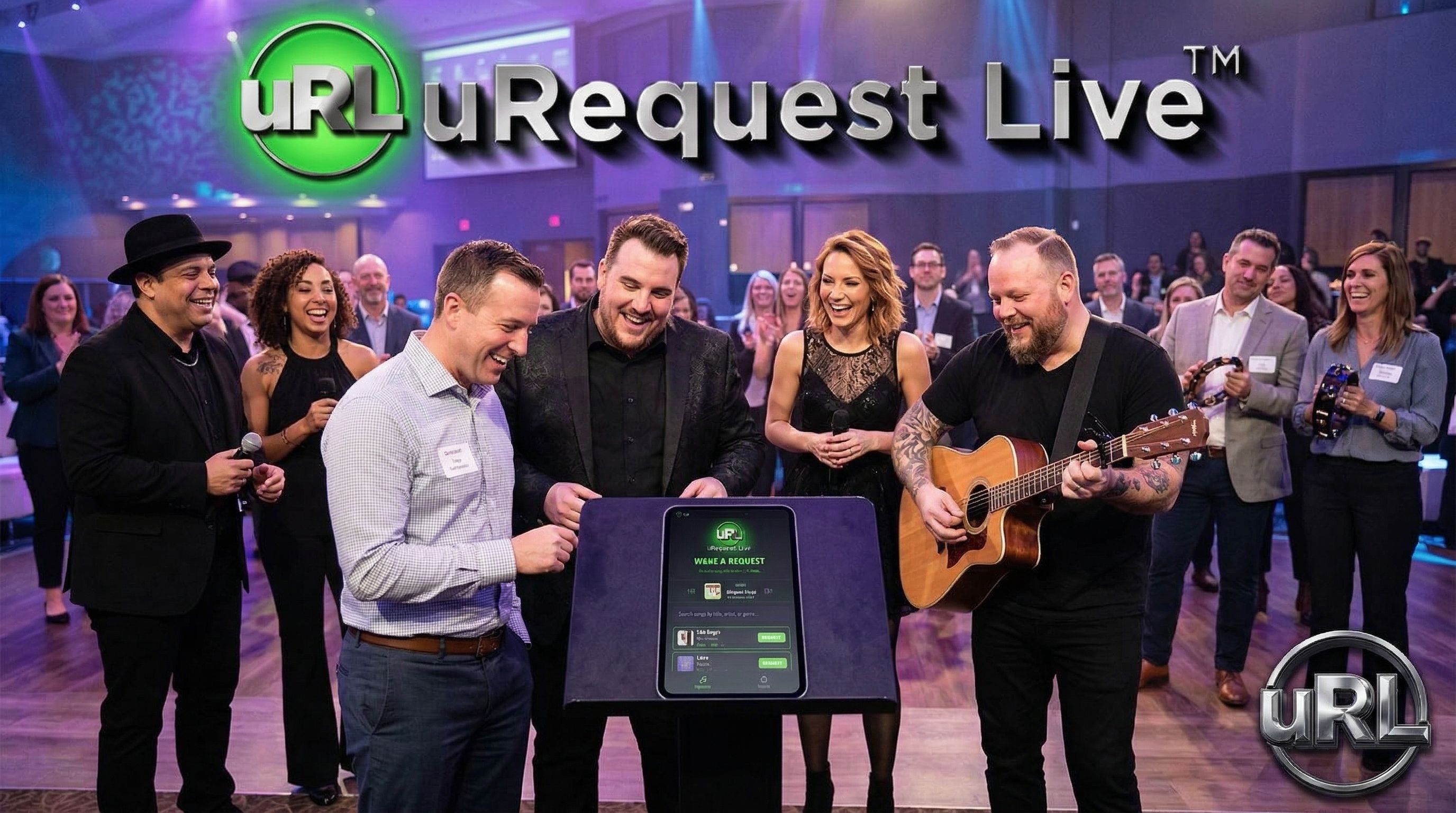
This is our bread and butter at uRequest Live, and it consistently produces the strongest team building outcomes. A live band performs songs chosen by the audience through a real-time voting system. Departments compete to get their songs played. Coworkers discover shared music tastes. The dance floor becomes the great equalizer.
What makes this format particularly effective for team building is that it requires zero talent or bravery from participants. You don't have to sing, play an instrument, or do anything embarrassing. You just have to have an opinion about music — and everyone does.
Department DJ Battles
Teams curate playlists that represent their department's personality, then compete for crowd approval. Marketing might go all-in on current pop; engineering might surprise everyone with obscure 80s deep cuts. The competition is friendly, the stakes are low, and the insights into team personality are genuine and often hilarious.
Music Trivia Nights
Cross-functional teams compete in music trivia, combining knowledge of genres, decades, and musical history. This format is particularly effective for mixing departments that don't normally interact, as music knowledge crosses all organizational boundaries.
Collaborative Playlist Building
For virtual or hybrid teams, collaborative playlist creation can be surprisingly powerful. Teams build playlists around themes (road trip songs, Monday motivation, Friday wind-down) and present them to the group. The discussion about why certain songs were chosen reveals personality and values in a way that feels natural rather than forced.
The Cross-Generational Bridge
One of music's unique advantages for team building is its ability to bridge generational gaps. A typical corporate team spans three or four generations — from Gen Z to Baby Boomers. Finding common ground across these demographics is one of the biggest challenges in organizational culture.
Music cuts through generational barriers because it works in both directions. The 25-year-old discovers that their 55-year-old colleague has impeccable taste in classic rock. The senior executive learns a new artist from an intern's song request. These micro-discoveries create relationship threads that extend well beyond the event.
What the data says about music-based team building:
- 78% of participants rate music-based events as their preferred team building format
- Teams report 35% improvement in cross-departmental communication within 30 days post-event
- 92% of attendees describe the experience as "genuinely fun" vs. 41% for traditional team building
- Employee satisfaction scores increase by an average of 12 points following music-based team events
Designing Music-Based Team Building for Impact
Pre-Event: Set the Stage
Send a pre-event survey asking employees for their top three songs. This does double duty: it builds anticipation and provides data that helps customize the experience. When people see their pre-submitted songs in the request library, they feel the event was designed for them.
During the Event: Create Shared Moments
The best team building happens in unplanned moments. Your job is to create the conditions for those moments to emerge. An interactive concert naturally produces them — the spontaneous group singalong, the department that forms a dance circle, the unlikely pair who bond over a shared favorite band.
Post-Event: Extend the Connection
Create a shared playlist after the event with the songs that were played. This gives the team a tangible artifact of the shared experience — something they can return to that triggers the positive associations from the evening. It's a remarkably effective way to extend the bonding effect for weeks or months.
The Business Case
If you need to justify the investment to leadership, here are the numbers that matter. Deloitte's research on team dynamics shows that high-trust teams are 50% more productive than low-trust teams. Music-based experiences build trust faster and more reliably than conventional methods, making them not just more enjoyable but more efficient as a team development investment.
The cost comparison also favors music-based approaches. A multi-day off-site team building retreat costs $500-$1,000 per person when you factor in travel, accommodation, and facilitation. A music-based team building event costs $30-$80 per person and delivers stronger bonding outcomes in a single evening.
Build a Stronger Team Through Music
Discover how interactive music creates genuine team bonds — no trust falls required.
Plan Your Team EventFrequently Asked Questions
Why is music effective for team building?
Music activates neural synchronization — when people listen to or create music together, their brainwaves literally align. This neural coupling creates feelings of connection and trust that are difficult to achieve through conventional team building exercises.
What are the best music-based team building activities?
Interactive concert experiences with song voting, drum circles, band battle competitions between departments, collaborative playlist creation, and music trivia events all work well. The best activities combine low barriers to entry with high emotional payoff.
How does musical team building compare to traditional activities?
Research shows that shared musical experiences produce 4x higher oxytocin levels than conventional team building activities. Unlike escape rooms or ropes courses, music-based team building doesn't create performance anxiety or physical discomfort.
Can music-based team building work for remote or hybrid teams?
Yes, with adaptation. Virtual music trivia, collaborative playlist building, and live-streamed interactive concerts where remote attendees vote alongside in-person guests all bridge the remote-hybrid gap.
How long should a music-based team building event last?
The sweet spot is 2-3 hours. This allows time for initial warm-up (30 minutes), the core interactive experience (60-90 minutes), and organic socializing afterward.